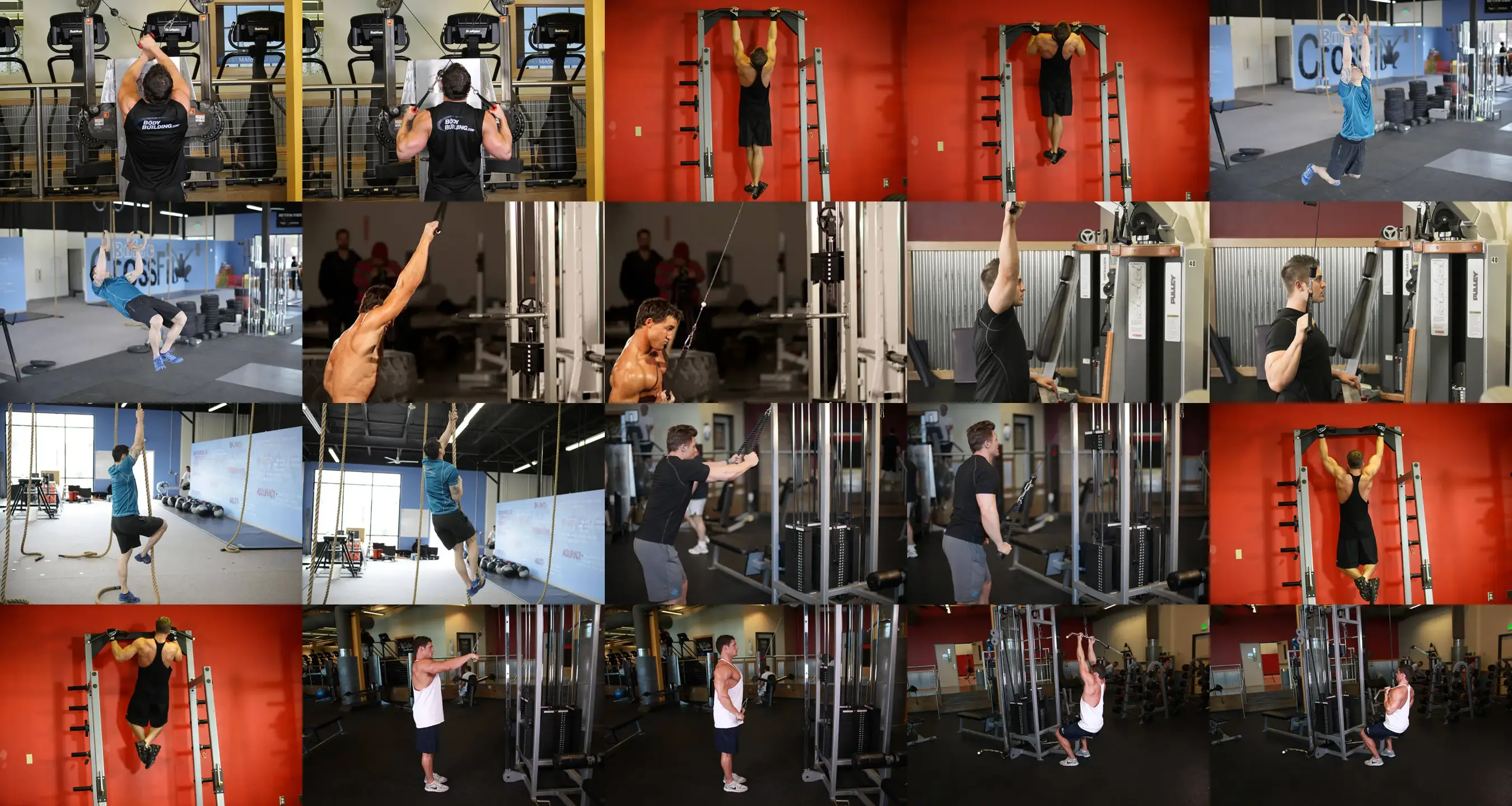
Setup and loading
Hang the rings high enough that you can dead hang with straight arms and feet off the floor. Before trying it, aim for about 8 strict pull-ups and 10 ring dips; otherwise build up with progressions first.
How to do the kipping ring muscle-up step by step
- Hang with a false grip, wrist over the ring, arms straight, and rings parallel with each other.
- Start the swing under control: chest forward into an arch, then hips forward into a hollow position.
- Coming out of the arch, snap your hips up hard and pull the rings toward your hips with nearly straight arms.
- Keep the rings tight to your body and, as you float, whip your elbows back to bring your chest over your hands.
- Catch the bottom of the dip with elbows back and chest leaning forward, then press until your arms lock out.
- Lower under control through the dip to a hang, or drop to a hang and restart the swing for the next rep.
Form cues
- Snap your hips before you bend your arms
- Keep the rings close to your ribs
- Get your chest over your hands fast
- Lock out at the top with fully straight elbows
Common mistakes
- Losing the false grip during the swing: the transition stalls; reset your grip before pulling.
- Bending your arms too early: you waste the hip drive; pull only as your hips rise.
- Letting the rings drift away from you: it pushes your mass away; keep them close to your torso.
- Flaring your elbows in the dip: it stresses the shoulder; keep them tucked and back on the catch.
How to make it easier or harder
To regress, drill ring swings, feet-on-the-floor transitions, and chest-to-ring pull-ups. To progress, move to a strict muscle-up with no kip or link several kipping reps together without touching the floor.
Sets and reps for your goal
Hypertrophy
3-4 x 8-12 · rest 60-90 s3-4 sets of 6-12 reps (up to 15-20 on isolation exercises) at 65-80% of your max. Rest 1 to 2 minutes.
Get close to failure (0-3 reps in reserve) and control the lowering for 2-3 seconds. Accumulate 10-20 sets per muscle per week.
Max Strength
4-5 x 3-6 · rest 2-3 min3-6 sets of 1-6 reps at 80-90% of your max (1RM). Rest 2 to 5 minutes.
Leave 1-3 reps in reserve. If your technique breaks down, lower the weight: strength is built with good reps.
A guide for healthy adults. Adjust the load to your level and see a professional if you have an injury.
Check your form
Film yourself from the side or ask someone to watch, then tick what you get right.
Frequently asked questions
How many pull-ups do I need for a muscle-up?
A good benchmark is about 8 strict pull-ups and roughly 10 ring dips. You also need a reliable false grip and a controlled kip, because technique matters as much as raw strength for this skill.
Should I learn it on rings or a bar?
Rings let your hands rotate and your body pass close, so the transition often feels more natural. A bar has a fixed path and relies more on momentum. Many coaches start people on low rings first.
Sports it suits
Gear for this exercise
- Suspension trainerAnchors to a door or a bar.
As an Amazon Associate, Muscle Atlas earns from qualifying purchases.