Setup and loading
Choose a ball that puts your knees at roughly 90 degrees when seated, and set your feet hip-width apart. Start with bodyweight and, once you hit 15 clean reps, add a dumbbell or plate across your hips.
How to do the stability ball hip bridge step by step
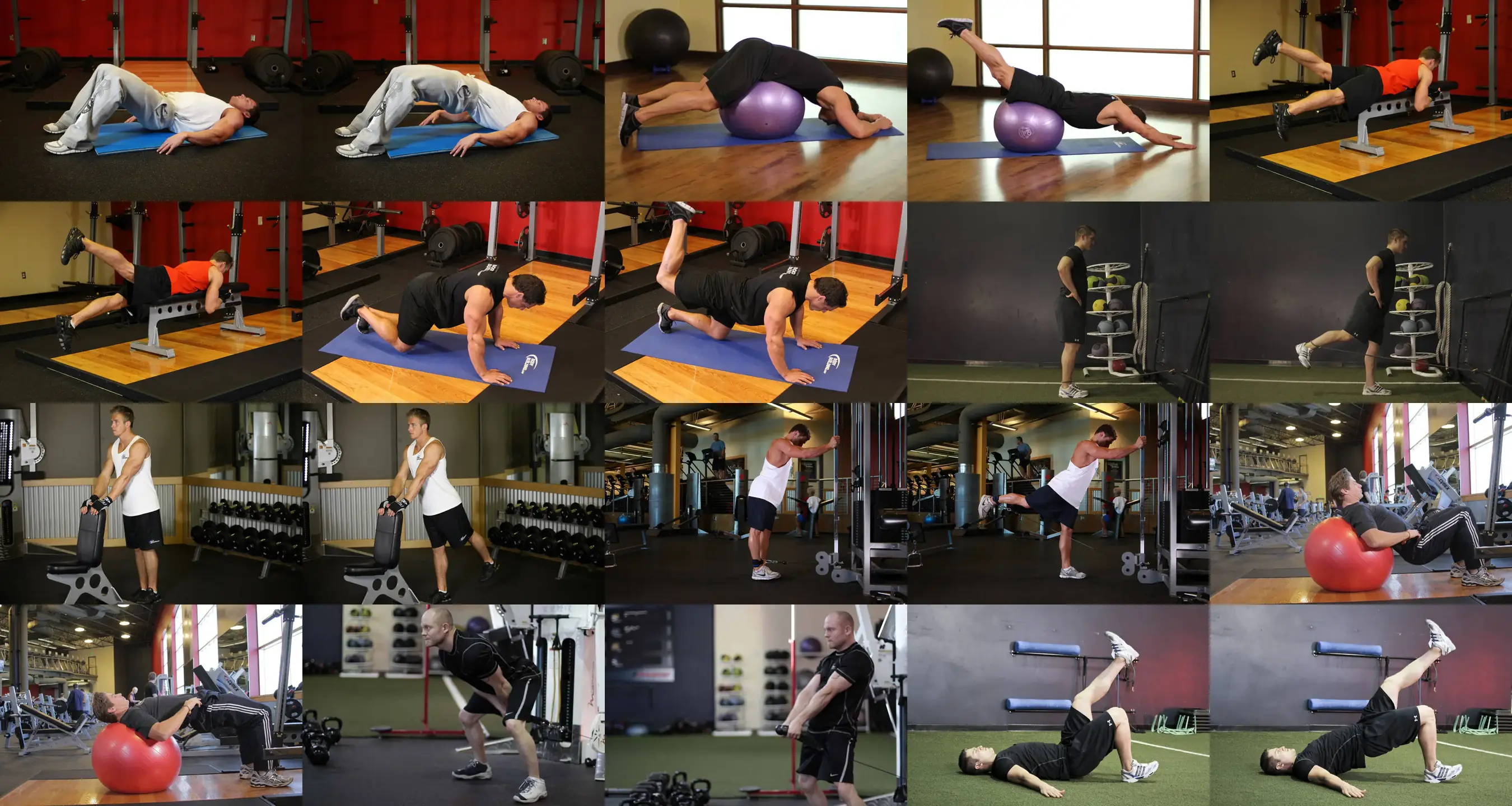
- Sit on the ball and walk your feet forward until your upper back and shoulder blades rest on top of it.
- Plant your feet flat at hip width, knees over ankles, with arms crossed over your chest or out to the sides.
- Let your hips sink toward the floor while keeping your upper back on the ball and the ball still.
- Exhale and drive through your heels to lift your hips until your shoulders, hips, and knees form a straight line.
- Squeeze your glutes for one or two seconds at the top, ribs down and pelvis slightly tucked.
- Inhale as you lower your hips slowly, keeping the ball steady, and repeat without losing your upper back position.
Form cues
- Drive the floor away through your heels
- Ribs down with no lower back arch
- Knees stacked over ankles at the top
- Squeeze your glutes before you lower
Common mistakes
- Arching your lower back at the top: your back replaces your glutes; pull ribs down and brace.
- Feet too close to the ball: it shifts work to your quads; walk them out to 90 degrees.
- Letting the ball roll around: you lose position and control; move slowly and keep it still.
- Knees caving in or flaring out: it stresses the joint; keep them in line with your feet.
How to make it easier or harder
If balance is tough, start with a floor glute bridge or a hip thrust with your back on a bench. To progress, add a dumbbell across your hips, try a single-leg version, or move to the barbell hip thrust.
Sets and reps for your goal
Hypertrophy
3-4 x 8-12 · rest 60-90 s3-4 sets of 6-12 reps (up to 15-20 on isolation exercises) at 65-80% of your max. Rest 1 to 2 minutes.
Get close to failure (0-3 reps in reserve) and control the lowering for 2-3 seconds. Accumulate 10-20 sets per muscle per week.
Max Strength
4-5 x 3-6 · rest 2-3 min3-6 sets of 1-6 reps at 80-90% of your max (1RM). Rest 2 to 5 minutes.
Leave 1-3 reps in reserve. If your technique breaks down, lower the weight: strength is built with good reps.
Speed
4-6 x 10-30 m or 5-10 s · full rest4-8 reps of 10-40 meters (or 3-6 seconds). Full rest: 1 minute for every 10 meters.
Always at 95-100%. If your time gets more than 3-5% slower or your technique falls apart, stop: running tired trains endurance, not speed.
A guide for healthy adults. Adjust the load to your level and see a professional if you have an injury.
Check your form
Film yourself from the side or ask someone to watch, then tick what you get right.
Frequently asked questions
How is it different from a bench hip thrust?
The movement is nearly identical, but the ball is unstable, so your core and hip stabilizers work harder. A bench is stable and lets you load much heavier, which makes it better for building strength.
What size stability ball should I use?
As a rough guide, a 55 cm ball fits most people from about 5 feet 1 to 5 feet 7, and a 65 cm ball up to about 6 feet 1. When seated, your knees should be level with your hips.
Sports it suits
Gear for this exercise
- Stability ballPick the diameter for your height (55-65 cm for most people).
As an Amazon Associate, Muscle Atlas earns from qualifying purchases.